Certified Compliant Scanning: How Your Photocopiers Can Produce Legally Valid Copies
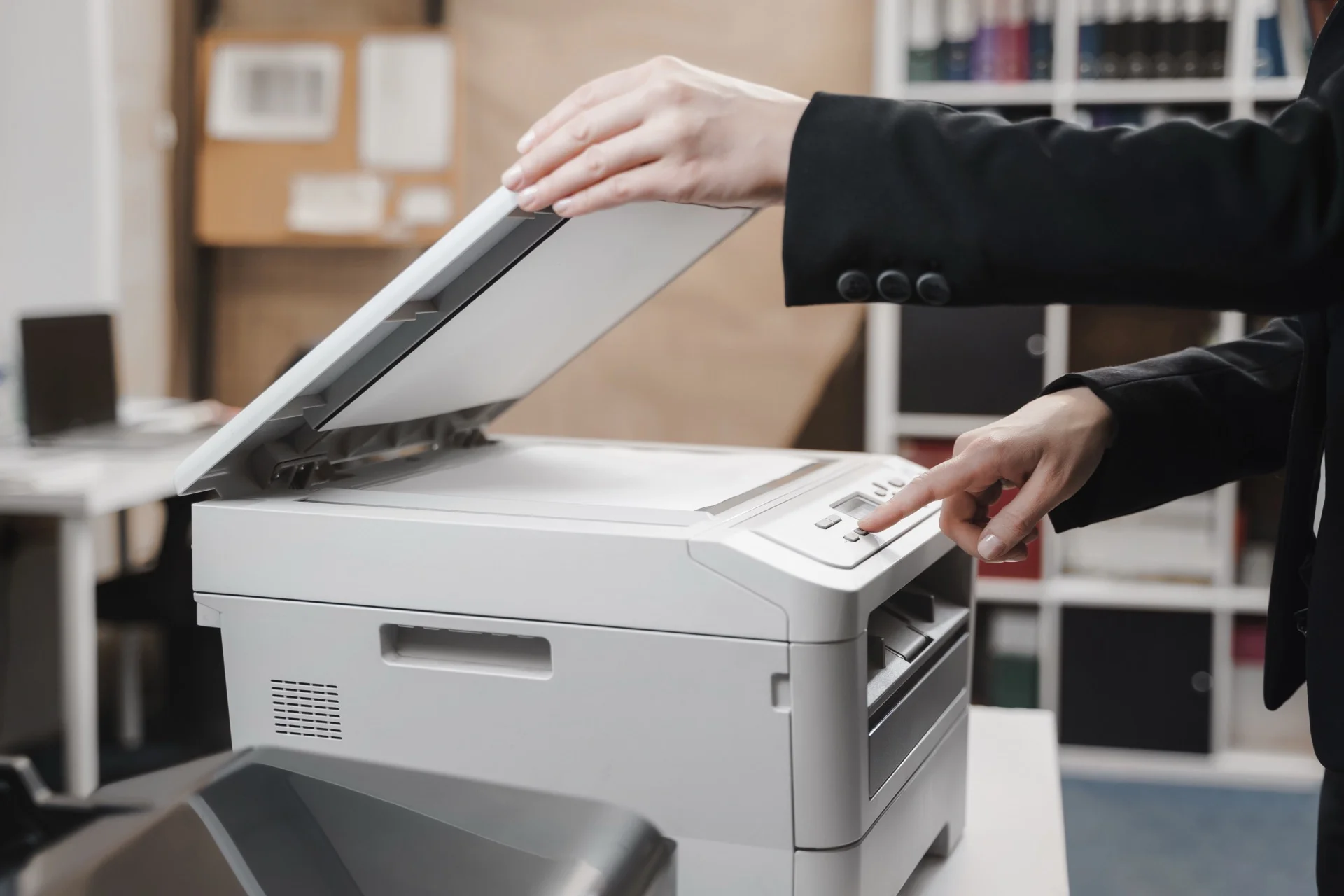
Certified Compliant Scanning: How Your Photocopiers Can Produce Legally Valid Copies
In a world where document digitisation has become essential, a crucial question arises for businesses: how can you ensure that your digital copies have the same legal value as the original paper documents? The answer lies in certified compliant scanning, a feature increasingly present on modern professional photocopiers.
What is Certified Compliant Scanning?
Certified compliant scanning is a process that creates digital copies of paper documents with evidentiary value equivalent to the original. Unlike simple scanning, this process incorporates technical and legal mechanisms that guarantee:
- Document integrity: no modification possible after scanning
- Authenticity: the document’s origin is verifiable
- Traceability: every step of the process is recorded
- Timestamping: the date and time of scanning are certified
The European Legal Framework
In Belgium and the European Union, the eIDAS Regulation (electronic IDentification, Authentication and trust Services) governs electronic signatures and digital trust services. This regulation, supplemented by national standards, defines the technical criteria that certified scanning systems must meet.
The NF Z42-026 standard in France and its European equivalents establish the requirements for a digital copy to be considered “faithful and durable” in the legal sense.
Why Does Your Business Need Certified Scanning?
1. Legal and Tax Compliance
Belgian businesses are subject to strict document retention obligations:
- Invoices: minimum 7 years retention
- Accounting documents: 10 years
- Contracts: variable duration depending on their nature
- HR documents: up to 30 years for some
Certified scanning allows you to destroy paper originals while retaining their legal value, freeing up considerable storage space.
2. Reduction of Legal Risks
In the event of litigation, a document scanned without certification can be challenged by the opposing party. A certified compliant copy, on the other hand, benefits from a presumption of integrity before Belgian courts.
3. Process Optimisation
Certified dematerialisation fits perfectly into an electronic document management (EDM) approach, enabling:
- Instant access to archived documents
- Keyword search thanks to OCR
- Secure sharing between colleagues
- Automatic backup in the cloud
Essential Features of a Certifying Photocopier
To produce scans with legal value, your professional photocopier must integrate several technologies:
Qualified Electronic Signature
The photocopier must be able to apply a qualified electronic signature compliant with the eIDAS regulation. This signature guarantees:
- The identity of the signatory (the company or operator)
- Document integrity (any subsequent modification is detectable)
- Non-repudiation (impossible to deny having signed)
Certified Timestamp
A timestamp token issued by a recognised certification authority attests to the exact date and time of scanning. This point is crucial for documents with a temporal scope, such as contracts or invoices.
Complete Metadata
The system must automatically capture and integrate:
- Scanning resolution (minimum 200 DPI recommended)
- File format (PDF/A for long-term archiving)
- Identifier of the device used
- Operator information
Secure Logging
A tamper-proof audit log records all operations performed: who scanned what, when, and on which device. This traceability is essential in case of dispute.
How to Implement Certified Scanning in Your Business?
Step 1: Assess Your Needs
Start by identifying the types of documents requiring certified scanning:
- Documents with high legal value (contracts, deeds)
- Tax documents (invoices, expense reports)
- HR documents (employment contracts, payslips)
- Technical documents (patents, plans)
Step 2: Choose the Right Equipment
Not all photocopiers offer certified scanning. Major brands such as Canon, Ricoh, Konica Minolta and Xerox offer integrated solutions or additional modules. When making your choice, check:
- Compatibility with European standards (eIDAS)
- Integration with your existing EDM system
- The possibility of rental or leasing including this functionality
- Technical support available in Belgium
Step 3: Configure Workflows
A certifying photocopier must be correctly configured:
- Definition of authorised user profiles
- Configuration of signature certificates
- Connection to the timestamp server
- Setting up secure storage destinations
Step 4: Train Your Teams
Certified scanning requires following specific procedures. Train your staff on:
- Document preparation (removing staples, checking condition)
- Using the photocopier interface
- Post-scanning quality control
- Managing originals after scanning
Step 5: Define an Archiving Policy
Develop a documented procedure specifying:
- Documents covered by certification
- Retention periods
- Conditions for destroying paper originals
- Those responsible for each step
Concrete Benefits for Your Business
Space Savings
One cubic metre of paper archives equals approximately 10,000 documents. Once scanned and certified, these documents fit on a few gigabytes, freeing up precious square metres in your Brussels premises or elsewhere.
Financial Savings
Physical storage costs are considerable:
- Rental of archive spaces
- Storage furniture
- Air conditioning and fire protection
- Document search time
Certified scanning can reduce these costs by 60 to 80% according to studies.
Business Continuity
Certified digital documents, stored in the cloud and replicated across multiple sites, withstand disasters (fire, flood, theft) much better than paper archives.
Simplified Compliance
When facing tax audits or inspection requests, being able to instantly present certified digital documents significantly speeds up procedures.
Most Affected Sectors
Law Firms and Notaries
The need to retain deeds and case documents for decades makes certified scanning particularly relevant.
Healthcare Sector
Patient records must be kept for 30 years. Certified scanning makes it possible to meet this obligation while facilitating access to health data.
Accounting and Finance
Tax obligations require rigorous retention of supporting documents. Certification guarantees their admissibility in case of audit.
Human Resources
Employment contracts, payslips, various certificates… HR documents to be retained are numerous and sensitive.
Pitfalls to Avoid
Don’t Confuse Simple and Certified Scanning
A standard scan, even in high resolution and PDF format, has no particular legal value. Only scanning incorporating certification mechanisms offers evidentiary value.
Don’t Neglect the Chain of Trust
Certification only has value if the entire chain is secure: from scanning to storage, including transmission. A weak link compromises the whole.
Don’t Forget Training
High-performance equipment that is poorly used does not produce compliant results. Investment in training is as important as the equipment itself.
Don’t Underestimate Organisational Aspects
Technology doesn’t do everything. A clear document policy and rigorous procedures are essential.
The Future of Certified Scanning
Several trends are emerging for the coming years:
Artificial Intelligence
AI will soon enable automatic classification of scanned documents and detect anomalies or fraud attempts.
Blockchain
Some systems are beginning to use blockchain to guarantee the integrity of scanned documents, offering an additional level of security.
Increased European Standardisation
The European Union is working to further harmonise requirements for certified scanning, facilitating cross-border exchanges.
Conclusion: A Strategic Investment
Certified compliant scanning is no longer a luxury reserved for large companies. With photocopier rental solutions integrating this functionality, even Belgian SMEs can benefit from this technology at lower cost.
By choosing the right equipment and implementing the right procedures, you transform your company’s document management while legally securing your digital archives.
Ready to take the step? Contact us to discover the certified photocopier solutions suited to your business. Our experts will guide you through the choice, installation and configuration of your equipment, whether you are located in Brussels or elsewhere in Belgium.
Article updated on 4 March 2026. The legal information presented is provided for guidance only and does not constitute legal advice. Consult a legal professional for your specific situation.
📍 Service available in: Brussels