Printer vs Photocopier: What Are the Differences?
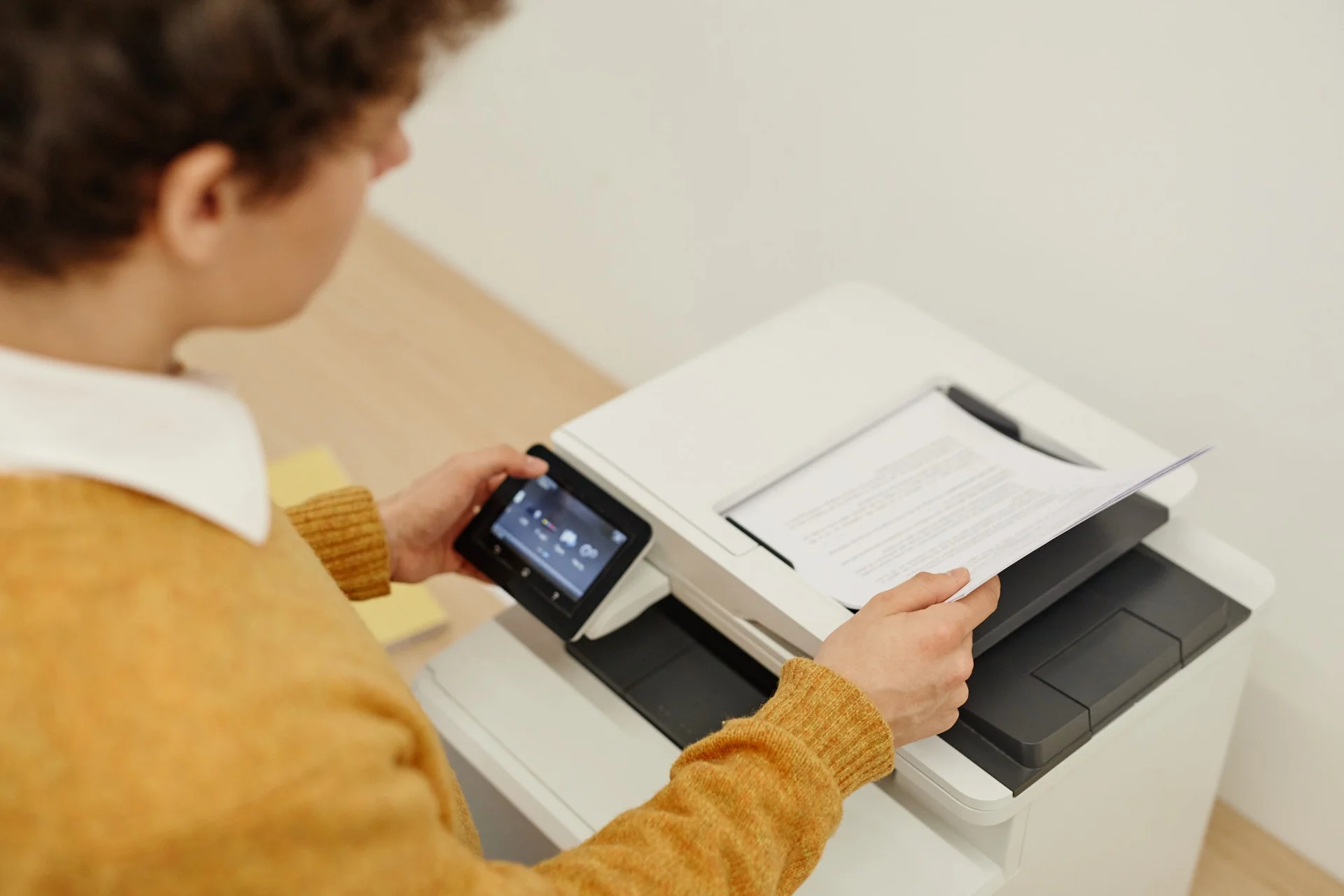
In an increasingly digital world, printers and photocopiers remain essential tools for individuals and businesses. These devices, although distinct, meet complementary needs in terms of document production and reproduction. Printers are designed to create documents from digital files.
They use various technologies, such as inkjet or laser printing, to transfer ink onto paper. Photocopiers, on the other hand, specialise in reproducing existing physical documents. They work by scanning the original document and printing copies.
Technological evolution has led to the development of multifunction printers, which combine printing, scanning and photocopying capabilities in a single device. These devices offer increased versatility and are particularly suited to modern office environments. In the professional context, these devices play a crucial role in written communication and document management.
They enable the printing of reports, presentations and marketing materials, as well as the duplication of important documents. With the increase in remote working and flexible workspaces, demand for efficient and remotely accessible printing and photocopying solutions has intensified. The costs associated with these devices vary depending on their capacity, speed and features.
Individual printers are generally less expensive to purchase but may have higher operating costs in terms of consumables. Professional photocopiers and multifunction printers represent a larger initial investment but often offer a lower cost per page for large print volumes.
Summary
-
Printers and photocopiers are essential devices in a modern office environment.
-
Printers work by transferring digital data onto paper, whilst photocopiers reproduce existing documents.
-
Printers are ideal for low to medium print volumes, whilst photocopiers are better suited for high volumes of document reproduction.
-
Printer operating costs are generally higher due to ink cartridge purchases, whilst photocopiers have higher costs related to maintenance and spare parts.
-
Printers offer the convenience of home printing, whilst photocopiers are better suited for high-volume document reproduction.
How Printers Work and Their Use
Printers operate according to various technological principles, the most common being inkjet and laser printing. Inkjet printers spray tiny drops of ink onto paper to create images and text. This process allows for great precision and high print quality, particularly for colour images.
In contrast, laser printers use a laser beam to transfer toner powder onto paper, giving them impressive print speed and superior energy efficiency. Each type of printer has its own specifics in terms of speed, cost per page and print quality, which influences users’ choices based on their needs.
Printer use has also diversified with the advent of wireless technologies and mobile applications. Today, it’s possible to print directly from a smartphone or tablet thanks to dedicated applications or Wi-Fi connectivity. This evolution has considerably simplified the printing process, making access to printing more convenient than ever. Moreover, modern printers are often equipped with advanced features such as automatic duplex printing, cloud scanning and even the ability to print from online services.
These innovations have transformed the way we interact with these devices daily.
How Photocopiers Work and Their Use
Photocopiers, meanwhile, rely on a different principle: photocopying is generally performed by a process called electrophotography. This process involves using a photosensitive drum that is electrically charged. When the original document is placed on the photocopier glass, a light scans the document and creates an electrostatic image on the drum.
Then, toner is attracted to this image and transferred onto paper to create a faithful copy of the original document. This mechanism allows photocopiers to quickly produce multiple copies of the same document whilst maintaining consistent quality.
Photocopier use is particularly widespread in offices where the need to reproduce documents is frequent. Whether distributing documents during meetings or archiving important information, photocopiers play a crucial role in document management. Moreover, modern photocopiers often integrate advanced features such as scanning to email or to a network folder, which further facilitates information sharing and archiving. In short, these devices have become indispensable in any environment where efficient document management is paramount.
Cost Differences Between Printers and Photocopiers
When evaluating the costs associated with printers and photocopiers, several factors must be considered. Generally, the initial cost of a printer is often lower than that of a photocopier, especially when considering models intended for home or personal use. However, it’s essential to consider the total cost of ownership, which includes not only the purchase price but also recurring costs such as ink or toner, paper and maintenance.
Inkjet printers may seem cheaper to buy, but their ink cartridges can be expensive to replace, especially if printing frequently. On the other hand, photocopiers are generally designed for intensive use and can offer better cost-effectiveness in the long term for businesses that need to produce a large volume of copies. Although their initial price is higher, their cost per page is often lower thanks to their ability to print quickly and efficiently.
Additionally, some photocopiers offer maintenance contracts that include toner and spare parts supply, which can further reduce overall costs. Thus, the choice between a printer and a photocopier should be guided by a thorough analysis of specific printing and reproduction needs.
Advantages and Disadvantages of Printers
Printers have several notable advantages that make them a popular choice for individual users and small businesses. First, their ability to produce high-quality prints, particularly for colour images, is a major asset. Modern models also offer a wide variety of features such as wireless printing and integrated scanning, which improves their versatility.
Moreover, with the rise of multifunction printers, it’s now possible to perform multiple tasks with a single device, saving space and simplifying document management. However, despite these undeniable advantages, printers also have certain disadvantages. One of the main drawbacks lies in the high cost of consumables such as ink or toner.
For those who print frequently, these costs can quickly accumulate and make using a printer less economical in the long term. Additionally, some printers can be slow when printing large volumes of documents, which can be frustrating in a professional environment where time is precious. Finally, maintenance can also be a challenge if one doesn’t have the technical skills needed to resolve common problems.
Advantages and Disadvantages of Photocopiers
Photocopiers also offer a series of advantages that make them particularly attractive for businesses with high document reproduction needs. Their ability to quickly produce multiple copies of the same document is undoubtedly one of their main assets. In an environment where time is essential, this speed can make all the difference.
Moreover, modern photocopiers are often equipped with advanced features such as scanning to email or to a network folder, which further facilitates information sharing within an organisation. However, like any technological device, photocopiers are not without disadvantages. Their initial cost can be prohibitive for some small businesses or individual users who don’t need high reproduction capacity.
Additionally, although designed for intensive use, their maintenance can sometimes be complex and require the intervention of a qualified technician. Finally, it should also be noted that some models may have lower print quality than the best inkjet or laser printers when printing colour images or detailed graphics.
Which Device to Choose for Your Specific Needs?
The choice between a printer and a photocopier largely depends on the specific needs of each user or organisation. For those who primarily need to print documents from digital files and are looking for high image quality for colour or photo prints, a multifunction printer might be the best option. These devices offer unparalleled flexibility with their printing, scanning and sometimes even faxing capabilities in a single compact device.
On the other hand, for businesses that frequently need to reproduce large volumes of documents, a photocopier may be more suitable. Photocopiers are designed to handle intensive use and offer a lower cost per page for large volumes. Additionally, they often come with maintenance contracts that include toner and spare parts supply, which can reduce overall costs.
Ultimately, the choice should be based on a thorough analysis of your specific needs, taking into account print volume, required quality, and available budget.
Need a Professional Photocopier?
Get free personalised quotes from qualified suppliers in Belgium. Response within 24 hours, no obligation.