Smart scanning and OCR on a photocopier in Belgium: automate your documents in 2026
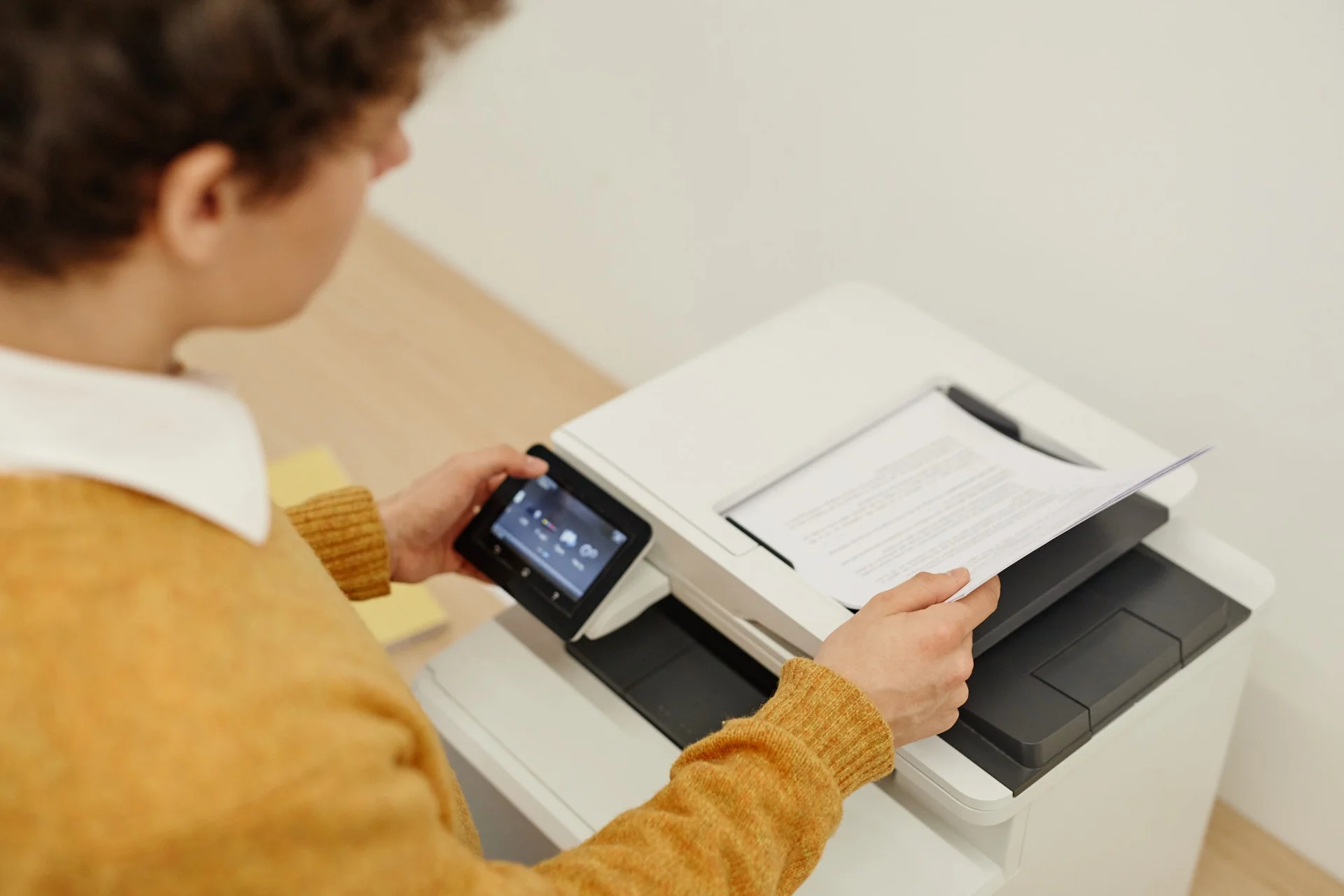
Smart scanning and OCR on a photocopier in Belgium: automate your documents in 2026
For years, the photocopier was seen as little more than a machine for printing, copying and scanning. In 2026, that view is outdated. In many Belgian SMEs, the multifunction device has become a document automation hub: it captures paperwork, recognises text, renames files, classifies documents and sends them to the right cloud platform or folder.
That is why OCR and smart scanning matter so much. OCR turns a scanned image into usable, searchable text. Smart scanning goes one step further by applying rules: detecting document type, extracting data, sending files to the right destination and reducing manual handling.
For Belgian businesses, this is no longer a nice extra. It is a practical way to save time, reduce mistakes and make hybrid work smoother. If your team still scans everything to a generic mailbox, you are probably paying for that habit in hidden delays every week.
If you are still comparing equipment models, it is also worth looking at rental, leasing and our complete guide to rental, leasing or purchase.
What does OCR actually do?
OCR stands for Optical Character Recognition. It allows the text inside a scanned document to be recognised so the resulting PDF is not just an image.
With OCR, your scan becomes:
- searchable;
- indexable;
- easier to archive;
- more useful for later retrieval;
- more valuable for compliance and internal workflows.
Without OCR, scanned PDFs often become digital dead ends. With OCR, they become operational documents.
What makes smart scanning different?
Smart scanning combines OCR with workflow logic. A well-configured device can:
- identify whether a document is an invoice, contract or HR file;
- extract information such as date, supplier name or reference number;
- create a standard file name automatically;
- place the file in the correct folder;
- send it to SharePoint, OneDrive, Google Drive or a DMS;
- trigger a simple validation step if needed.
In short, OCR reads, while smart scanning organises and routes.
Why this matters in Belgium in 2026
Belgian companies increasingly operate in a mixed paper-digital environment. Some documents are born digital, while others still arrive on paper or are printed, signed and rescanned. That creates friction which is rarely measured properly.
The limits of scan-to-email
Scan-to-email was an important first digital step. But it quickly creates familiar problems:
- documents scattered across inboxes;
- poor file naming;
- no shared source of truth;
- slow retrieval;
- weaker control over access and retention.
Modern multifunction devices with cloud connections solve much of that.
High-value use cases: accounting, legal and HR
Teams that process many structured documents gain the most from smart scanning. That includes accountants, law firms and SMEs with strong internal administration.
In Belgium, this matters even more because companies are expected to process documents faster whilst preserving confidentiality and keeping teams aligned across office and remote work.
What a smart scanning workflow looks like
Let’s take a simple example. A company receives supplier invoices, signed agreements and paper-based administrative mail.
Without automation, someone will usually:
- scan the documents;
- email them to themselves or a shared inbox;
- rename the files manually;
- move them into the right folders;
- alert another colleague;
- fix mistakes later.
With a well-configured multifunction device, the process becomes much simpler:
- the user taps a button such as “Supplier invoices”;
- the machine scans both sides and applies OCR;
- it recognises key fields;
- it creates a clean file name;
- it sends the document to the correct cloud location or DMS;
- it can also notify the right team automatically.
The real gain comes from removing repetitive micro-tasks after the scan.
Which documents should you automate first?
The best approach is to start with high-frequency, standardised documents.
Supplier invoices
Invoices are usually the best first use case because they follow recognisable patterns and have obvious business value.
Contracts and amendments
For legal, sales and management teams, searchable contracts are a major time saver. OCR makes retrieval by keyword, client name or reference much easier.
HR files
Employment contracts, certificates and internal forms are still often handled partly on paper. Automatic filing reduces mistakes and improves access control.
Delivery notes and logistics documents
In logistics or industrial settings, smart scanning can make proof-of-delivery and order documents much easier to find.
Practical benefits for a Belgian SME
Less admin time
Many SMEs underestimate how much time is lost renaming, sorting and searching. Smart scanning targets exactly that burden.
Better search and retrieval
An image-only scan is hard to work with later. An OCR-enabled document becomes searchable and useful.
Fewer filing mistakes
Manual classification leads to typos, duplicate storage and misplaced files. Good automation improves consistency.
Better continuity in hybrid work
Documents are immediately stored in a shared space instead of being trapped in one person’s inbox. That is especially useful for companies operating across locations. On that point, our article on multi-site printing in Belgium is closely related.
Example: an accounting firm in Brussels
Imagine a 12-person accounting firm in Brussels receiving paper invoices, client records and signed documents every day.
Before
- scans sent to a generic mailbox;
- files named
scan_001.pdf; - manual sorting;
- duplicate copies in several folders;
- frequent delays when searching for documents.
After smart scan setup
- buttons for “Invoices”, “Contracts” and “HR”;
- automatic OCR;
- storage in SharePoint;
- standard file naming;
- full-text search.
Likely outcome
- reduced admin time;
- fewer misplaced files;
- smoother collaboration between office and remote staff;
- faster response to clients.
This kind of project is often introduced through a flexible solution in Brussels or as part of a device renewal.
Features to demand from your photocopier
Not every scanner-enabled device is suitable for document automation. Check these points carefully.
Custom buttons on the touchscreen
Users should not have to rebuild the settings for every scan.
Reliable OCR in several languages
In Belgium, documents often move between Dutch, French and English. Language support matters.
Cloud or DMS connectors
The destination is just as important as the scan quality.
Fast duplex scanning
If you scan batches, throughput matters.
Easy administration
If every adjustment requires an external technician, adoption will suffer.
Brands such as Canon, Ricoh and Kyocera often support these functions, but configuration remains the real differentiator.
Common mistakes to avoid
Trying to automate everything at once
Start with two or three high-value flows, not fifteen.
Designing a workflow nobody will use
A technically elegant process is useless if it does not match daily habits.
Ignoring security
Automation must still respect permissions, traceability and storage rules.
Overlooking scan quality
Poor originals, folds or bad orientation can seriously weaken OCR accuracy.
Rental, leasing or purchase?
For this kind of productivity project, many Belgian businesses favour flexibility. The value is not only in the machine itself, but also in software, connectors, updates and support.
Rental is often attractive when you want fast access to modern equipment without heavy upfront investment. Leasing may suit companies looking for stable monthly costs. If you want to assess deployment options locally, our page on a photocopier in Brussels is also a useful starting point.
What ROI can you expect?
The return usually comes from combined gains:
- less time spent sorting files;
- fewer lost documents;
- fewer duplicate scans;
- fewer internal back-and-forth requests;
- less reliance on one employee who “knows where everything is”.
These gains often look modest individually but become significant very quickly.
How to launch the project simply
- Identify 3 recurring paper workflows.
- Define one clear destination per workflow.
- Standardise file naming.
- Keep the user interface simple with 4 or 5 scan buttons.
- Measure time saved after 30 days.
Conclusion
In 2026, the best photocopier is not simply the fastest one. It is the one that fits into your document processes. Smart scanning and OCR help Belgian companies manage invoices, contracts and files with less friction, better searchability and stronger collaboration.
The real question is no longer whether your photocopier can scan. Almost all of them can. The real question is: what happens after the scan? If the answer is still “we deal with it later in email”, there is probably a clear productivity opportunity waiting.
If you want to modernise document flows in Brussels, Liège or elsewhere in Belgium, compare solutions based on your volume, software environment and archiving needs. Good projects often begin with one simple observation: which documents are still taking your team too long to process?